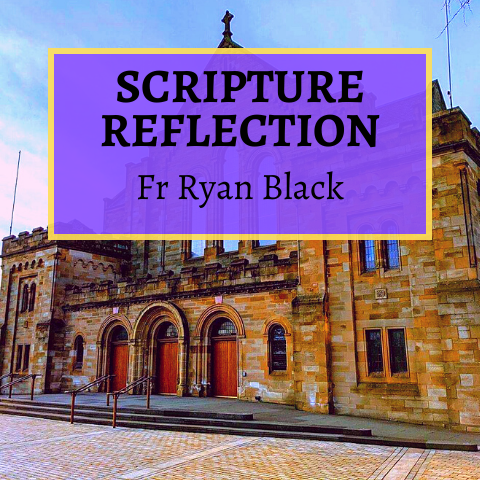
Fr Ryan Black’s homily on the Solemnity of the Dedication of St Mirin’s Cathedral.
Today, our parish and diocesan communities celebrate the great feast of the dedication of this cathedral. Here, in the mother church of the diocese, the feast is raised to a solemnity, and it is with great joy that we celebrate the anniversary of such an important moment in the history of Paisley and of Scottish Catholicism.

The first reading, from the prophet Ezekiel, comes from the prophet’s great vision of a restored temple and a new covenant. Ezekiel had this vision in Babylonian exile; God assured the Israelites that all was not lost—that there was hope—and that he had not forgotten them. The vision, which takes up the final nine chapters of the book of the prophet, has as one of its highlights the account we have just heard: the glory of the Lord descending on the new temple and filling it.
In the Gospel, Christ asks the disciples who people say he is. Remember that this takes place in Caesarea Philippi, a pagan territory surrounded by hills on which stood the shrines of idols. In the midst of the pagan cult, Peter affirms on behalf of the disciples that Jesus is the Christ, the son of the living God. Once again, the glory, the Word of the Lord, has descended upon the earth.
God has had many dwelling places upon the earth. He walked with Adam in the garden; he led the wandering Israelites through the desert in a pillar of cloud and fire; in the desert, he dwelt in the tabernacle, the great tent built by Moses; in Jerusalem, he was to be found in the glorious Temple on Mount Zion.
Now, though, he dwells in every chapel, oratory, church, cathedral and basilica in which we find a tabernacle and a lit sanctuary lamp. How is this possible? In the past, he dwelt very obviously in one place; now, he dwells in several. This is one of the great mysteries of the Eucharist: Christ has given himself entirely to us and, once again, the Lord has descended upon the pagans.
This cathedral and everything in it have one purpose. The beautiful stained-glass windows, the incredible sandstone pulpit; the stunning marble altar and the impressive statues… all of them were put in place to give glory to God, who dwells among us in the tabernacle.
But bricks and mortar come and go. Perhaps the greatest mystery of the Eucharist is that through it, we become living stones in the Church of God. How much has this coronavirus pandemic helped us to appreciate the importance of our churches, of this cathedral? And yet, these building—even St Peter’s Basilica—pale in insignificance when compared with the one, true Church of Christ, whose members we are.
We are the eternal, living stones of the Church, built around the cornerstone rejected by the builders. It is our rightful place in life to stand next to him and never to be moved. Let us give thanks to God today for the gift of St Mirin’s Cathedral, and let us give thanks to him for the gift of the one, true, holy, Catholic and apostolic Church.
No responses yet